

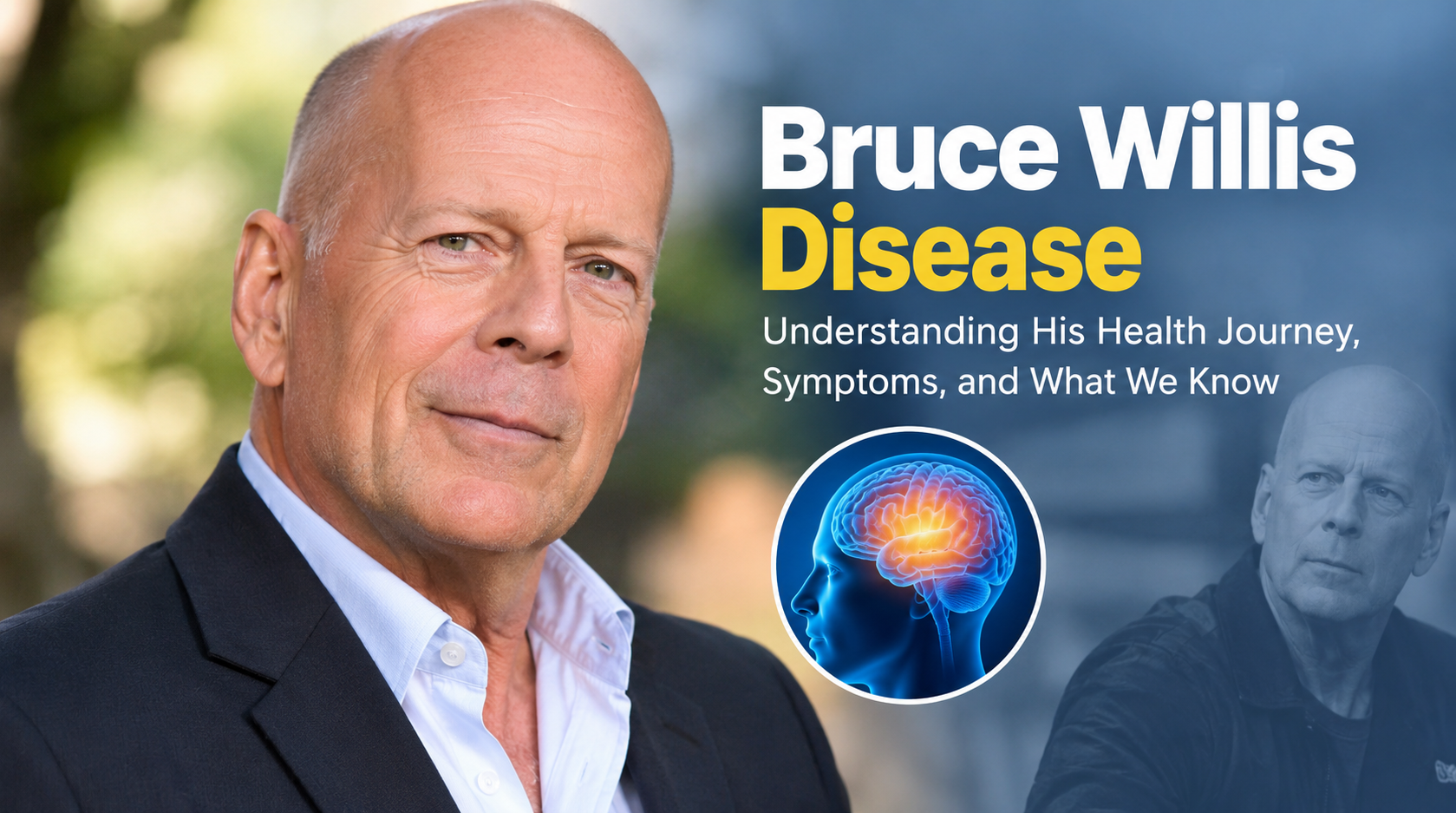
Bruce Willis is one of Hollywood’s most recognizable actors, known for memorable performances in films such as Die Hard, Pulp Fiction, The Sixth Sense, and The Fifth Element. Over the years, fans have watched his career evolve from television success into international stardom. In recent years, however, public attention has shifted from his acting career to questions about his health.
The phrase “Bruce Willis disease” is now closely associated with frontotemporal dementia, commonly known as FTD. His family first announced that he had been diagnosed with aphasia in 2022. In February 2023, they shared that his condition had progressed and that he had received a more specific diagnosis of frontotemporal dementia.
Understanding Bruce Willis’s diagnosis also helps explain a condition that many people know very little about. Frontotemporal dementia is not simply a problem with memory. It is a neurological disorder that can affect language, behavior, personality, decision-making, and other abilities depending on the areas of the brain involved.
What Disease Does Bruce Willis Have?
Bruce Willis has been publicly diagnosed with frontotemporal dementia, or FTD. The diagnosis was announced by his family in 2023 after an earlier diagnosis of aphasia. According to the family, communication difficulties were only one part of the condition he was experiencing.
Frontotemporal dementia is a group of progressive brain disorders that primarily affect the frontal and temporal regions of the brain. These areas play important roles in language, personality, behavior, judgment, and social interaction.
Unlike the dementia most people commonly associate with older age, FTD can occur relatively early in life. Its symptoms can look different from one person to another, which can sometimes make diagnosis difficult.
Bruce Willis and Frontotemporal Dementia
The term frontotemporal dementia covers several related forms of neurological disease. Some people initially experience major changes in language, while others notice changes in personality, behavior, judgment, or movement.
In Bruce Willis’s case, aphasia was one of the early publicly disclosed problems. His family later explained that his condition had progressed to a diagnosis of FTD. Because the family has chosen to keep many details private, it is important not to assume which specific symptoms he experiences or how advanced his condition may be.
The publicly confirmed diagnosis is enough to understand why his health became such an important topic without speculating about private medical information.
What Is Frontotemporal Dementia?
Frontotemporal dementia is a progressive neurological condition involving degeneration in the frontal and temporal lobes of the brain. These areas influence many abilities that are essential to everyday life, including communication, emotional responses, social behavior, and decision-making.
FTD can be particularly challenging because its early symptoms may not resemble traditional memory-related dementia. Someone might appear unusually impulsive, lose interest in activities, struggle to find words, or have difficulty understanding language.
The exact pattern depends on which parts of the brain are affected. This is one reason why frontotemporal dementia can be difficult to recognize in its early stages.
How FTD Can Affect Communication
Language difficulties can be one of the most noticeable features of frontotemporal dementia. A person may struggle to find the right word, understand certain words, construct sentences, or communicate thoughts clearly.
Aphasia is a term used to describe difficulties with language. It can have many different causes, including stroke and neurological disorders. In some forms of FTD, language problems can be among the earliest symptoms.
For someone whose career depended heavily on communication and performance, such changes can be especially difficult. However, aphasia does not mean that a person has lost their identity or emotional connection with the people around them.
What Were Bruce Willis’s First Publicly Known Health Problems?
Bruce Willis’s family announced in 2022 that he would step away from acting after receiving a diagnosis of aphasia. At the time, the condition was affecting his ability to communicate. His family later provided a clearer explanation when they announced his frontotemporal dementia diagnosis in 2023.
The progression from an initial aphasia diagnosis to a more specific FTD diagnosis illustrates why neurological conditions can sometimes take time to identify. Symptoms can overlap with other disorders, and doctors may need to evaluate how those symptoms develop over time.
For families, waiting for a clear diagnosis can be emotionally exhausting. At the same time, an accurate diagnosis can help patients and caregivers understand what they are facing and make more informed decisions about support and care.
Symptoms Associated With Frontotemporal Dementia
FTD symptoms can vary considerably. Some people experience major changes in personality or behavior. Others develop problems with language, communication, or movement.
Behavioral changes may include reduced social awareness, unusual impulsiveness, loss of empathy, repetitive actions, or changes in judgment. These symptoms can sometimes be mistaken for personality changes rather than signs of a neurological condition.
Language-related FTD can cause increasing difficulty speaking or understanding language. A person may know what they want to say but struggle to find the words needed to express it.
As the disease progresses, symptoms can become more complex. This is why medical evaluation is important when someone experiences persistent and unexplained changes in communication, behavior, or cognitive function.
Is Frontotemporal Dementia the Same as Alzheimer’s Disease?
Frontotemporal dementia and Alzheimer’s disease are both forms of dementia, but they are not the same condition.
Alzheimer’s disease commonly begins with problems involving memory and learning. FTD more often affects behavior, personality, executive function, or language in its earlier stages.
That distinction does not mean memory is never affected by FTD. As the condition progresses, different areas of cognitive function can become involved. However, the initial presentation can be quite different from what people traditionally imagine when they hear the word dementia.
This difference is important because recognizing the early pattern can help healthcare professionals investigate the correct diagnosis.
How Is Frontotemporal Dementia Diagnosed?

Diagnosing FTD generally involves looking at a person’s symptoms, medical history, cognitive abilities, neurological function, and changes over time. Doctors may use different assessments and brain-imaging techniques as part of the evaluation.
There is no single test that automatically identifies every case of frontotemporal dementia. Instead, physicians consider the overall pattern of symptoms and rule out other possible causes.
This can make the process complicated, especially when early symptoms appear subtle. Communication problems, personality changes, or unusual behavior may initially be attributed to stress, aging, depression, or other conditions.
A specialist in neurology or cognitive disorders can help determine whether further evaluation is needed.
Can Frontotemporal Dementia Be Cured?
At present, there is no cure that reverses frontotemporal dementia, and there is no established treatment that stops the underlying disease process. Research continues to explore possible therapies and better ways to diagnose and manage FTD.
Treatment and support generally focus on managing symptoms and maintaining quality of life. Depending on a person’s needs, speech and language therapy, occupational support, physical therapy, behavioral strategies, and other forms of care may play useful roles.
The goal is not simply to treat a diagnosis on paper. It is to help the person remain as comfortable, connected, and independent as possible for as long as circumstances allow.
The Role of Family and Caregivers
A dementia diagnosis affects more than the individual. It can change everyday life for spouses, children, relatives, friends, and professional caregivers.
Bruce Willis’s family has publicly spoken about the importance of compassion, privacy, and awareness surrounding his condition. Their decision to discuss FTD has also helped introduce many people to a neurological disorder they may never have encountered before.
Caregiving can be physically and emotionally demanding. Families dealing with dementia often need support themselves, particularly as responsibilities change over time.
One of the most valuable lessons from the Willis family’s public experience is that dementia should be approached with dignity rather than judgment. A person’s diagnosis does not erase their history, personality, relationships, or achievements.
Why Bruce Willis’s Diagnosis Has Raised Awareness
Bruce Willis has had a career spanning decades, making his health journey especially visible to the public. His diagnosis has brought greater attention to frontotemporal dementia and the communication difficulties that can accompany neurological disease.
His family has used their public platform to encourage greater understanding of FTD and the need for research. Their advocacy has also highlighted the experiences of caregivers, who often face challenges that receive far less attention than the diagnosis itself.
For many people searching for “Bruce Willis disease,” the first goal is simply to understand what happened to the actor. But learning about his diagnosis can also encourage people to recognize neurological symptoms in their own families and seek appropriate medical advice when concerns arise.
Bruce Willis Disease: What Fans Should Remember
Bruce Willis’s frontotemporal dementia diagnosis is a personal health matter, and much of his current condition remains private. Public information confirms the diagnosis, but it does not provide a complete picture of his everyday life.
That distinction matters. Celebrity health stories can quickly become filled with rumors, unverified claims, and exaggerated descriptions. A respectful approach is to focus on information confirmed by the person’s family or other reliable sources.
Bruce Willis’s legacy is also much larger than his illness. His decades of work have left a lasting impression on audiences around the world, and his health journey has brought attention to a disease that remains poorly understood by the general public.
FAQs
What disease does Bruce Willis have?
Bruce Willis was publicly diagnosed with frontotemporal dementia, or FTD, in 2023 after initially being diagnosed with aphasia.
What is frontotemporal dementia?
Frontotemporal dementia is a progressive neurological condition that can affect language, behavior, personality, judgment, and movement.
Did Bruce Willis have aphasia?
Yes. His family announced an aphasia diagnosis in 2022 before later confirming his more specific diagnosis of frontotemporal dementia.
Is frontotemporal dementia curable?
There is currently no cure that reverses FTD or stops its underlying progression. Treatment focuses mainly on symptom management, support, and quality of life.
Is Bruce Willis still acting?
Bruce Willis stepped away from acting after his health difficulties became public. His family has emphasized his wellbeing and privacy rather than a return to his acting career.
Conclusion
The story behind “Bruce Willis disease” is ultimately a story about frontotemporal dementia, a complex neurological condition that can affect language, behavior, personality, and other abilities. His diagnosis has helped bring much-needed attention to FTD and the families who live with it.
While Bruce Willis’s health remains largely private, his journey has encouraged greater awareness, compassion, and understanding. His impact extends far beyond his diagnosis, and his remarkable body of work continues to be remembered by audiences around the world.
